
Making more space for innovation in public procurement
I was recently invited to join Dynamo North East's Leadership Forum, bringing together North East technology leaders to explore how we might reimagine public procurement and social value.
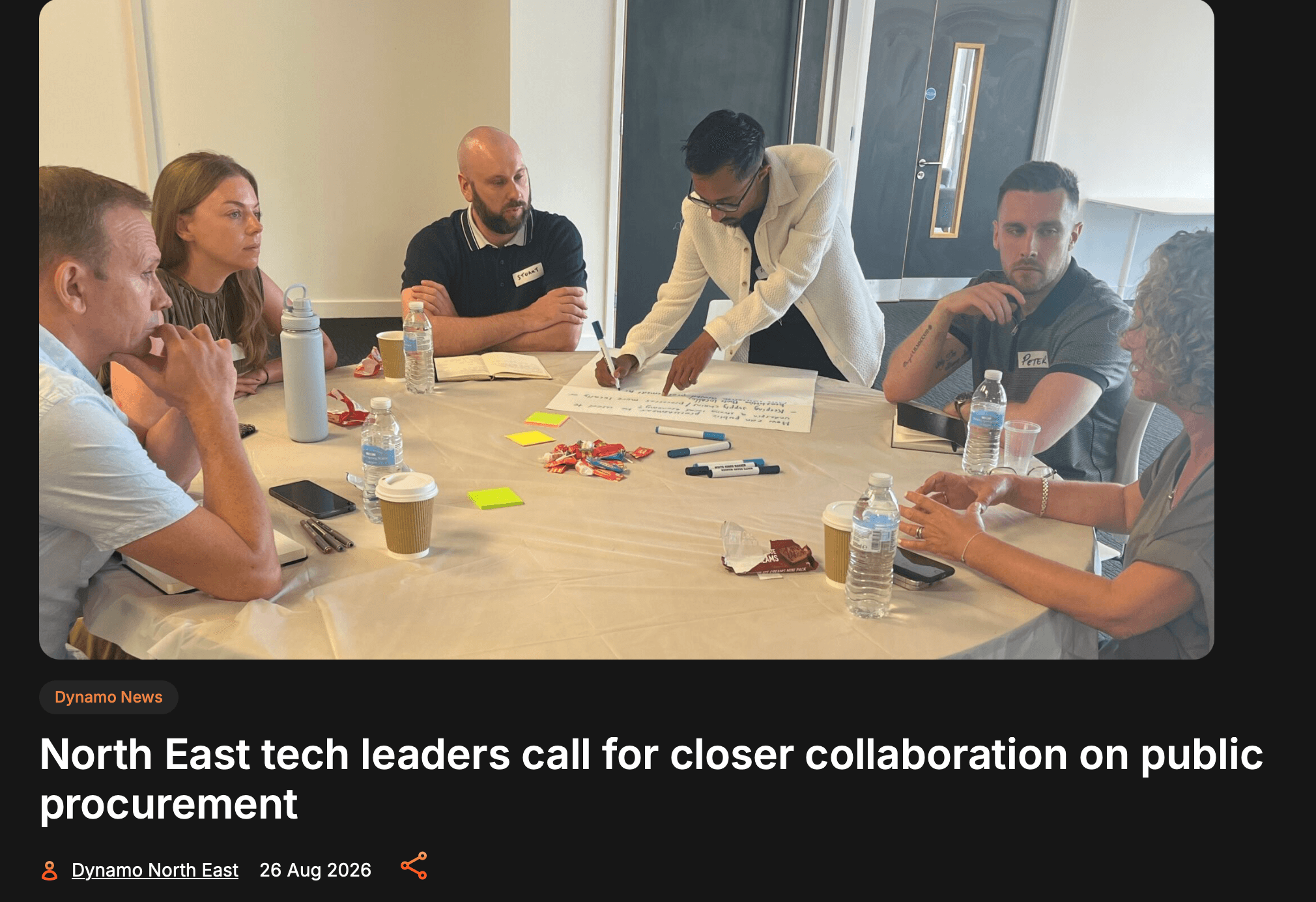
I was recently invited to join Dynamo North East's Leadership Forum, bringing together North East technology leaders to explore how we might reimagine public procurement and social value.
It was a really interesting conversation, and one question has been bouncing around in my mind since...
How do we create more space for innovation within public procurement?
Public procurement has to do some really important, non-negotiable things - it needs to manage risk, ensure fairness and transparency, ensure value for money and protect public money.
But in my experience of working across complex public-sector transformation, some procurement processes end up being designed around having the answer fully specified upfront and that can make it difficult for genuinely innovative ideas to emerge.
If we already know exactly what the solution needs to look like (because a good Discovery, Alpha has been completed!), that approach can make sense. But what happens when we know the problem we need to solve, but don't necessarily know enough about what the best solution might be?
For me, this is where the idea of creating the conditions for innovation becomes key. As innovation isn't simply about finding an innovative supplier or buying innovative technology, it's about creating enough space for better ideas to emerge in the first place.
Start with the problem, not the solution
One place to start is by being really clear about the problem or outcome we're trying to achieve, without necessarily deciding too early what the solution should look like. That sounds straightforward, but it's not always that easy.
If a procurement specification effectively defines the answer before suppliers have had an opportunity to bring their experience and ideas to the table, we risk narrowing the possibilities before the process has really begun.
Giving suppliers more opportunity to respond to the problem rather than a predetermined solution could open up different approaches - including things we may not have thought were possible.
Create transparent, diverse space to learn before we procure
I'd also be interested in seeing more opportunities for suppliers to help shape our understanding of what is possible before we get into the formal procurement process.
Not conversations that give certain suppliers an unfair advantage, or to become a way of circumventing procurement rules, but deliberate and transparent opportunities to learn - for example, by ensuring there are a range of suppliers at the table from SMEs to larger organisations.
- What are we seeing elsewhere?
- What is now possible that wasn't possible a few years ago?
- Are we describing the problem in the right way?
- Are there approaches we haven't considered?
And could there be funded, opportunities for smaller discovery or pilot phases where the answer genuinely isn't clear yet in the interest of strengthening the outcome overall?
Learn from each other
There is another source of insight that I think we could make much better use of: each other.
In my experience, public-sector organisations are often trying to solve very similar problems. The front end of a service might look very different, but underneath there can be striking similarities (e.g. an application/payment/assessment process). So before starting from scratch, could we be better at asking:
- Who else has already tried to solve this?
- What did they learn? What worked? What didn't? What would they do differently?
That learning can also help us have better conversations with the market. If we understand what has already been tried, we are in a much stronger position to understand where there might be genuinely new opportunities.
I think suppliers and independent practitioners like me have a role to play in doing some of this “dot joining” - seeing patterns across multiple public-sector organisations and bringing that learning into the room.
Give innovation room to evolve
Finally, if we're working on something where the answer isn't clear, perhaps we need to create more opportunities for learning and iteration throughout the journey.
This could mean creating appropriate opportunities to test assumptions during mobilisation, or it could mean recognising that learning continues after a contract is awarded, rather than treating the tender as the point at which everything becomes fixed.
This isn't about removing control or allowing scope to expand indefinitely, it's about recognising that learning is part of innovation.
Often we don't know what the best answer is until we've tried something, learned from it and adapted.
So what would I do differently?
When I'm working with organisations in these spaces, I don't start by trying to redesign its procurement process - it's rarely about that on its own. I start by looking at the conditions around it.
I'd work to understand where teams are currently getting stuck, how they define problems and outcomes, where they get their insight from, how they learn from what other organisations are doing, and when they engage with the market.
From there, I'd look for practical opportunities to create more space for exploration and learning - without compromising the governance and accountability that sit around public procurement.
That might mean bringing the right people together earlier, creating structured opportunities to explore the market around a problem, testing assumptions before committing to a major procurement, or finding ways to make learning and iteration part of delivery.
Creating the conditions
There is so much capability and innovation across the North East, and, of course, in other regions too. The challenge is creating the conditions for public services to access it.
For me, that means thinking about the whole procurement journey - and the space around it - rather than just the formal tender.
- How do we create opportunities to learn from suppliers? And how do we ensure a broad range of suppliers are at the table?
- How do we learn more from other public-sector organisations?
- How do we give ourselves permission to explore before we commit to an answer?
- And how do we do all of that while maintaining the transparency, accountability and fairness that public procurement needs?
I don't think there is one simple answer, but I do think there is an opportunity to think differently about how we create the conditions for using the market to support innovation so, ultimately, we can create better outcomes for the people who use public services.
Thanks to Dynamo North East for bringing such a broad group of people together to explore the wider topic around this. The resulting Reimagining Procurement and Social Value report is well worth a read.